Meet Report: 16-18 March 2026.
Glaisdale offers a different perspective of the North York Moors compared to recent meets which have been held further west in Carlton-in-Cleveland. Five members and three prospective members assembled at the well-appointed Bank House Farm bunkhouse in lovely Glaisdale, having negotiated the narrow lanes and farm track, and all arriving just in time for a light supper.
With dry, sunny weather in prospect, there were lots of ideas about possible outings. Mick had devised a varied circuit full of historical interest visiting four ancient crosses by old packhorse routes and finishing near a waterfall, and most elected to join him. Starting from the Forestry Commission car park at Old May Beck, a short walk took the party to John Cross, where just a stump in the socket stone remains. The next section southwards past Shooting House Rigg looked good when the walk was planned using satellite imaging, but a major wildfire in August last year had transformed large areas of the moor into a scorched and sterile wilderness.
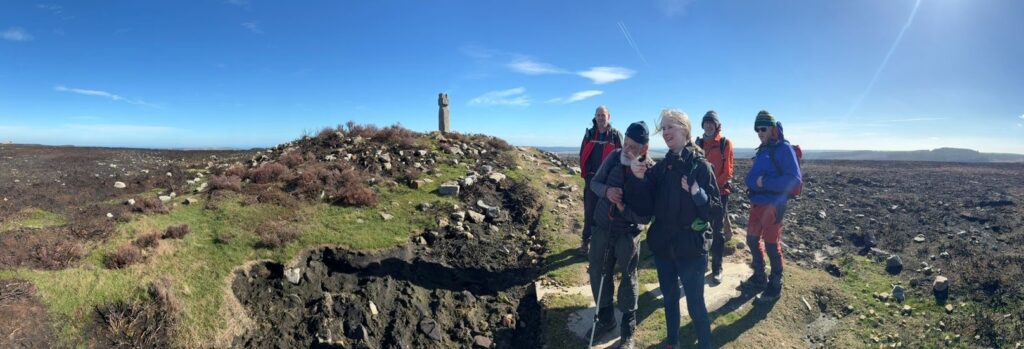
The medieval track of the Robin Hood’s Bay Road was followed through the blackened landscape to Lilla Cross on Lilla Howe, which stands beside the route of the Lyke Wake Walk. It may be a commemoration of Lilla, an Anglo-Saxon noble dating back to AD 626, but the cross itself is thought to date from the 10th century, making Lilla Cross the oldest on the North York Moors and it is regarded as one of the earliest Christian monuments in northern England. It is in remarkably good condition, and is primarily important as a boundary marker for the lands of the abbey at Whitby, and stands at the junction of four medieval parishes and the intersection of two medieval packhorse roads.
Ann’s Cross was next – a medieval wayside cross set into the top of a prehistoric barrow on Sneaton High Moor with just the socket stone with a broken cross shaft remaining. Not far away, York Cross on Whinstone Ridge was very similar but had a scattering of coins left by travellers – an old tradition still kept. After stopping to chat briefly with a JCB operator creating some new fire-breaks, we headed through the Newton plantation to Midge Hall, where May Beck tumbles 20 metres down Falling Foss, the highest waterfall in the North York Moors. A short walk through old deciduous woodland led back to our cars. We couldn’t find an open cafe so we were forced to stop for refreshments in a local hostelry on the way back.


Tim parked at Lockton near the foot of the Hole of Horcum and cycled across into Dalby Forest. He followed a 70km circular route involving a mix of forest gravel, singletrack paths and mountain bike trails. Strong headwinds on the southerly sections and some long hills made it quite an endurance test, but pausing to admire the splendid views which were to be had from the forest edges was some compensation.
Kev on his second meet with the YRC decided to walk from the bunkhouse. He headed down to Glaisdale village and on to the ford across the Esk then over to Lealholm Side. The Board Inn in Lealholm was unfortunately closed Tuesdays and no amount of sobbing at the door got it open! He then re-crossed the Esk and made his way up to the trig point on Glaisdale Rigg and finally followed a section of the Coast to Coast route, then back to the farm. On the way, he had a chat with a few locals/farmers and got a feel for the local history and geology. Beautiful dressed/carved stone work was everywhere- a testament to a dying art. A history of iron manufacture has not left too many scars thankfully, and lapwings and an abundance of pheasants completed the scene.


Kev left on Wednesday morning and with a long drive in prospect for several others, it was decided to exploit the T-shirt weather and walk a section of the Cleveland Way from Sandsend north to Runswick Bay along the cliff path. We briefly stopped at the Deep Grove Quarries which were worked in the 19th century for alum shale to produce alum which is a chemical used principally in the textile industry as a mordant for fixing dyes.
After climbing above the disused railway tunnel, we encountered a toad on the path which Mick relocated to a safer and shadier place. Fine views were enjoyed as we progressed along the cliff top path towards Runswick Bay where at John’s prompting we indulged in some fossil hunting. John claimed a large rounded limestone cobble packed with crinoids – an ancient fossil group that first appeared in the seas of the mid Cambrian, about 300 million years before dinosaurs and carried it off to join his collection.


After eating lunch on the benches beside the Inshore Rescue Boat Station, we climbed up through the village to our cars and said our farewells. All agreed it had been a cracking meet with excellent accommodation in a great location with very friendly hosts and blessed with excellent weather – we will have to return.
Martyn and Jim headed to Lowstern for the night and climbed Pen-y-ghent in the morning again in fine weather taking in Hull Pot on their return.


Attending: Mick Borroff, Kev Bird (PM), Pete Brackley (PM), Bev Eastwood, Jim Greaves (PM), Tim Josephy, John Sutcliffe, Martyn Trasler.
Leave a Reply